
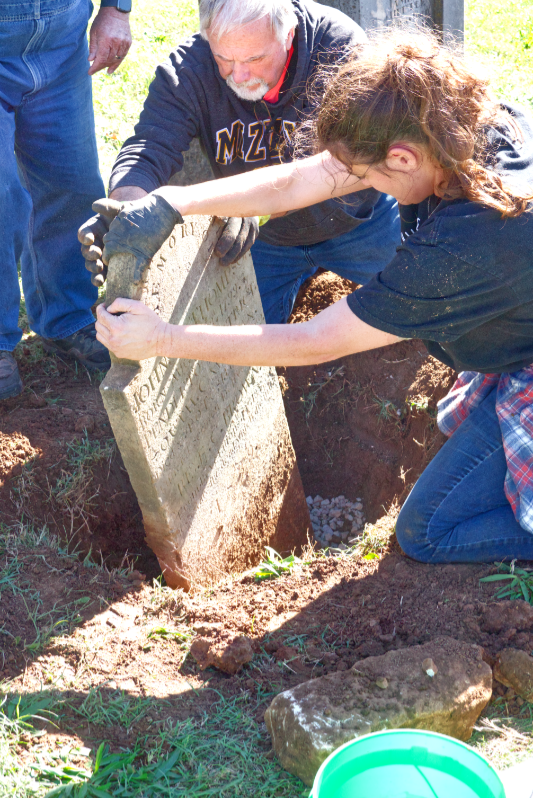
Potosi, MO — Two tombstones in the historic Potosi Presbyterian Cemetery, often standing in the shadow of town founder Moses Austin’s grave, now serve as a powerful physical connection to one of the darkest chapters in American history: the Trail of Tears. These weathered markers tell a deeply human story of survival, loss, and the devastating impact of forced removal, and were recently cleaned and reset by the Steelville Trail of Tears Remembrance Committee.
Lives Remembered
The nearly two-century-old granite markers memorialize Johnson Thompson and his young niece, Nancy J. Adair, who tragically died in Potosi during the brutal winter of 1838–1839. They were part of the final Cherokee group on the northern route, a detachment led by Richard Taylor known for high mortality due to severe weather and inadequate provisions.
While many details are lost to time, the gravestones provide rare, tangible evidence of the suffering endured as thousands of Cherokee were forced west to Indian Territory (present-day Oklahoma). Potosi lay along one of the main land routes, where hunger, disease, and exposure took many lives during an exceptionally harsh winter.
A Family’s Final Journey
It is believed Johnson Thompson assumed care of Nancy after her parents died earlier in the journey. Both fell ill near Caledonia, Missouri, were transported to Potosi for treatment, and ultimately passed away. Thompson’s stone had sunk and obscured engraving; after careful resetting and cleaning, all inscriptions are now visible.
The Inscriptions: Voices from the Past
Nancy J. Adair
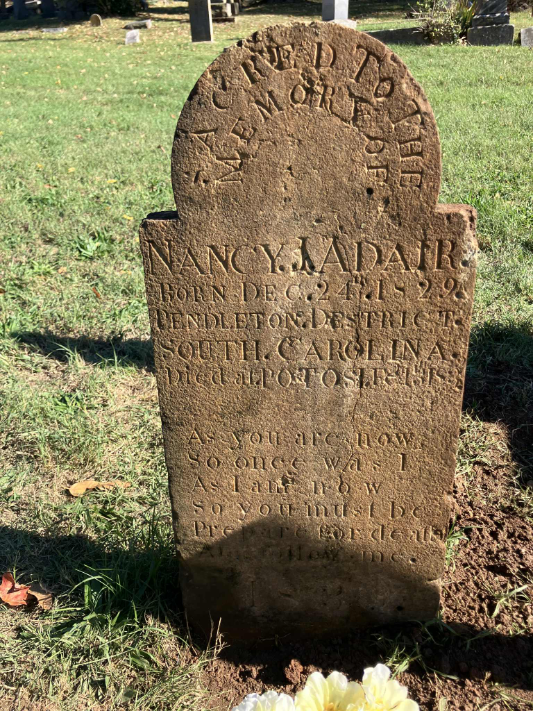
Nancy’s stone preserves her origin, dates, and a period memento mori verse common in 19th-century funerary language, underscoring mortality and moral readiness. The inscription records her birth in the Pendleton District of South Carolina and death in Potosi on February 13, 1839, emphasizing the youth and innocence lost on the journey.
Name: Nancy J. Adair.
Birth: December 24, 1829 — Pendleton District, South Carolina.
Death: February 13, 1839 — Potosi, Missouri.
Verse: “As you are now, so once was I; as I am now, so you must be; prepare for death and follow me.”
Original inscription (historic spelling and punctuation preserved)
A CRED TO THE MEMORY OF
NANCY J ADAIR
BORN DEC. 24, 1829
PENDLETON DISTRICT
SOUTH CAROLINA
DIED AT POTOSI, Feb. 13, 1839
As You Are Now
So Once Was I
As I Am Now
So You Must Be
Prepare For Death And Follow Me
Johnson Thompson
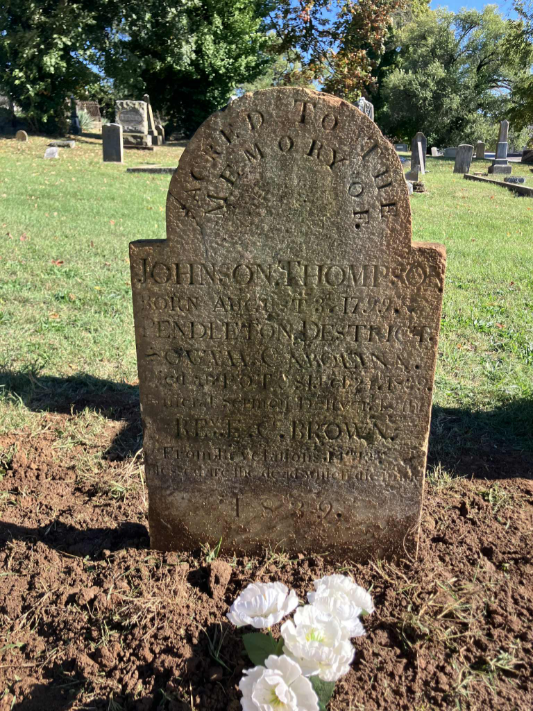
Johnson’s marker provides full biographical anchors and references a funeral sermon from Revelation 14:13, reflecting community efforts to memorialize the dead in faith terms amid crisis. The stone records his birth on August 3, 1799, and death in Potosi on February 24, 1839.
Name: Johnson Thompson.
Birth: August 3, 1799.
Death: February 24, 1839 — Potosi, Missouri.
Funeral sermon: Rev. E. C. Brown, from Revelation 14:13.
Original inscription (historic spelling and punctuation preserved)
A Cred To The Memory Of
Johnson Thompson
Born, August 3, 1799
Died at Potosi Feb. 24 1839
Funeral Sermon delivered by the
Rev. E. C. Brown
From Revelations 14, 13
Blessed are the dead which die in the
1839
Community Stewardship
This preservation effort is one of several projects led by the Steelville Area Historical Society’s Trail of Tears Remembrance Committee (a 501c3 subcommittee). The group seeks to honor the Cherokee, Muscogee (Creek), and enslaved people forced to walk the Northern Route of the Cherokee Trail of Tears, and to help the public understand the 1837–1839 period in local and national history.
Monument Initiative
The committee aims to fund a monument honoring those who died and were buried along the trail through Steelville and Crawford County, while recognizing the resilience of those who reached Indian Territory (Oklahoma). All donations benefit the planned monument.
Make checks payable to: STV HS ToT Memorial.
Mail to: Steelville Area Historical Society, 18 Cedar Lane, Steelville, MO 65565, or drop off at FCNB.
Learn more: https://trailoftears.steelvillehistoricalsociety.com/